
Released September 25, 2019
Developed by Nintendo
Published by Nintendo
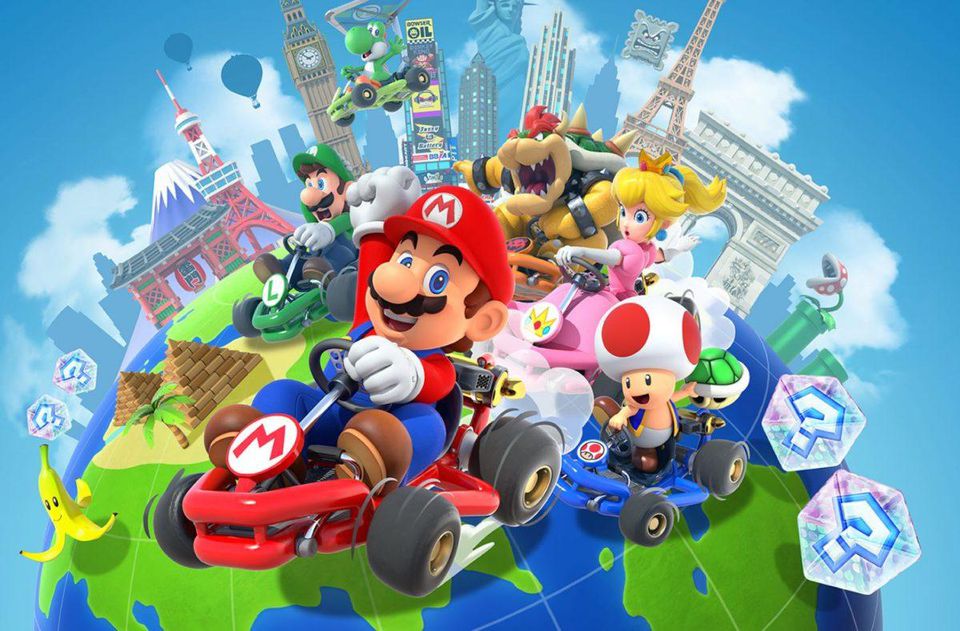
Mario Kart Tour is a free mobile racing game featuring gacha-style unlockable content. The game feels good to play in the moment, but that feeling can quickly go away upon realizing that a significant amount of content is locked behind a paywall, and nearly all of the content can be unlocked by paying for low percentage chances at it. Let’s see where it succeeds and fails at inducing flow.
Challenge and skill. Currently, there are very few options for different challenge levels in Mario Kart Tour. All races are against computer-controlled opponents, so the variable challenge level of PVP is not present. There are three different speed settings (or four if you purchase the monthly Gold Pass), which are the only real way the game offers different challenge levels. Different tracks might be more or less difficult than others, but they are not presented in an order of increasing challenge. Regarding skill, tracks can be replayed any number of times, and speed can be selected before beginning a race, allowing players to practice and hone skills. Other than learning the relatively simple controls, learning shortcuts or optimal routes through the various tracks as well as mastering the combination of tricks, items, and combos are the ways players can improve.
Goals. Mario Kart Tour makes goals very clear to players. Unlocking new races and gift boxes requires a certain number of stars. Stars can be acquired by reaching certain point thresholds on races, meeting certain goals in bonus challenge, or completing objectives on challenge cards. With the exception of some challenge cards (such as “Take out 3 pipes”), these goals are all obvious enough and quantified in a way that players can work towards them. The problem, however, is that not all of these goals are available without paying for the Gold Pass, and many are very difficult or extremely time-consuming without spending additional money on the game. The most obvious example is the Gold Pass exclusive challenge card, which is visible to all players, but only unlockable by paying players. The less obvious example is point goals for races. Points in races are earned in a variety of ways, but some things determine how many points can be earned before the race begins, such as which driver, kart, and glider the player is using as well as which speed setting the player has selected. All of these (except the highest speed setting which is locked behind the Gold Pass) can be unlocked by spending the game’s premium currency to purchase a random item from a large pool. The items that lead to the most points are the rarest at 0.33% chance to obtain one. Playing the game for about a week allowed me to earn enough premium currency through gameplay to purchase 20 items, and I got extremely lucky and obtained three different high-end items. However, this still leaves me missing several mid-rarity items and many more high-end items. Since different races give bonuses to players for using different items, this means that my ability to reach the point goals for certain races is extremely limited. An addition to the game that could correct for this would be a game mode that does not determine points by which items a player has obtained. Goals in such a game mode would be clear and attainable by all players.
Feedback. Mario Kart Tour does do a fairly good job of providing immediate feedback on the player’s actions. The user interface during a race lets the player know what place they are in, whether and which items they currently have, which lap they are on, their coin total, and their point total and current point combo. When landing a hit on an opponent or getting hit by one, the game tells the player who they hit or who they were hit by. Performing jumps or glide extensions results in a colorful animation. Any action that results in points appears on the screen, and a combo counter increases as the player performs consecutive actions. One big deficit in Mario Kart Tour’s feedback is regarding this combo counter, specifically that it does not tell the player how long they have left to perform an action to keep the combo going. A bar or timer counting down to the end of a combo would be helpful for extending combos as long as possible. Other than the combo counter, the gameplay during races feels very good, with everything else being very clear to the player. At the end of a race, the player can see their point total as well as how many points each individual action earned during the race. Overall, feedback is the flow condition that Mario Kart Tour satisfies the best.
Conclusion. For a free-to-play mobile game, Mario Kart Tour does a decent job of meeting the conditions of flow. Several additions could be made to improve the areas where it is lacking. Adding a multiplayer option to races, combined with a matchmaking system, would mostly solve the current challenge and skill problem. As for goals, the game does need to make money somehow, so removing the Gold Pass or the ability to pay money to unlock content faster seems unlikely. One solution would be the addition of a mode that does not take premium content into consideration and puts everyone on an even playing field, similar to the bonus challenges, but with deeper goals. Feedback is the game’s strong suit, with gameplay being reinforced by clear and immediate feedback on nearly every action the player can take. Mario Kart Tour is built on the strong foundation of the Mario Kart series, and it does a fairly good job at adapting the series to a free mobile game.
 Game Flow