
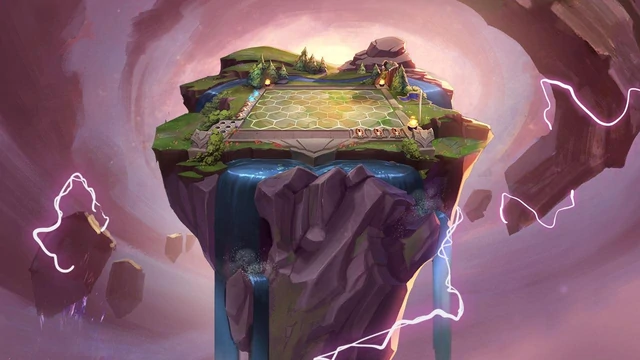
Released June 25, 2019
Developed by Riot Games
Published by Riot Games
This week’s review will be a slightly more unique case than previous reviews. First, this week’s game is very new and still considered to be in beta, so changes are being made on a continuing basis. As such, this review will function more as a “before” screenshot of the game that we can look back on in the future to check for progress. And second, the game is entirely player-versus-player, as opposed to the single-player games we’ve looked at so far. This will have implications primarily for the challenge and skill components of flow. With all of that in mind, let’s take a look at League of Legends’ newest game mode: Teamfight Tactics.
Challenge and Skill. Teamfight Tactics is a strategy autobattler, so the majority of the challenge involves knowledge and implementation of effective and appropriate strategies. Because it is also PVP, the exact level of challenge depends on the opponents. However, there are still ways that the player can improve their own skills in order to match potentially high challenges.
Strategic decisions must be made quickly, so fast thinking is a required skill in order to perform well. Thinking can be made faster through practice and by possessing knowledge of the possible decisions available to the player at any given time. Knowing which champions work well together as well as which items will most benefit them is key to forming and carrying out an effective strategy. This is an area where Teamfight Tactics will need to improve. Currently, there is no in-game compendium that lists champions and items. There is also no way to practice game mechanics without actually starting a full game with other players. Additions of these sorts would give players the ability to practice strategizing in a stress-free environment.
The other main component of challenge, which is related to strategizing, is the other seven players and how strong the teams they create are. This is partly a result of the other players’ skill, but luck also plays a role in determining each player’s team strength. Since the champions available for purchase and the items (if any) that drop from monsters are random, one player might get a significant boost in power purely by chance. Of course, the game is not entirely random, so skill can be expressed in adapting to the changing and random circumstances. However, the game’s current state is such that significant swings can occur early in the game by chance, which makes for a lower challenge game for the player on the receiving end of the good luck and a higher challenge game for the other players. Future updates should balance randomness to some extent. For instance, all players should receive the same number of items from the first set of minion fights, but the items received could still be random. This would maintain the challenge of adapting to new situations while eliminating the problem of one player getting extremely lucky and receiving a huge boost.
Goals. As with any PVP game, the end goal is to defeat the opponent(s). In Teamfight Tactics, the way to do this is by constructing a powerful team. Goals related to this include obtaining multiple copies of the same champion to power them up, obtaining multiple different champions that have synergy with each other such as Knights or Nobles, and obtaining items that work well with the team. However, due to the randomness of the champions available for purchase and item drops, these goals are not always proximal. Certain champions will appear more frequently during earlier portions of the game, and others will not appear at all until later into the game, so the player can at least set relatively more proximal goals based on that information. However, the element of luck makes these goals variably proximal, and sometimes completely out of reach. When this happens, the goal might become to swap to a different team composition based on the available resources. As such, the goal of constructing a good team will include the more proximal goal of being on the lookout for opportunities to strengthen the current team or to pivot to a different one.
Feedback. This is the flow component that is currently most lacking in Teamfight Tactics. It is also the one that is most likely to receive significant improvements as the game undergoes updates. As it stands, there is a lot of information that is not available to the player. As mentioned above, there is no in-game compendium for champions or items, and very little information about them is available, even when the player has already obtained them. For champions, the only information the player is given is their health, mana, and a description of their ability. Most abilities have numbers included, such as how much damage they do, but it is not always clear what exactly the abilities do and the degree to which they do it. More detailed descriptions should be included in the future. Champion descriptions should also contain more detailed stats that include attack range, attack speed, armor, magic resist, attack damage, and ability power. Without these, it is up to trial and error to test which champion is stronger than another.
Teamfight Tactics does provide some immediate feedback. During combat, damage numbers are shown to help indicate which champions are doing the most damage. Different colors are used for physical damage and magic damage to help differentiate between sources of damage. A symbol appears next to the damage number of a critical hit, indicating that it did more damage than normal. Outside of combat, visual effects help tell the player roughly how strong a given champion is. When three of a single champion are collected, they combine into an upgraded version. This upgraded version is slightly larger than the previous version, and the border next to their health bar changes from bronze to silver or silver to gold. This feedback can help the player gauge how strong an opponent’s team is, or which champions their opponents are upgrading. Finally, whenever any player upgrades any champion this way, a message appears in the in-game chat telling everyone who upgraded which champion. When a champion is upgraded to its highest form, a global sound effect accompanies the chat message to draw further attention. These forms of feedback are good, but much more is possible and necessary for players to know immediately whether they are making good decisions.
Conclusion. Teamfight Tactics is still very young, and as such it has a lot of room for improvement. The PVP nature of the game means that there will almost always be a challenge of the appropriate level for any given player, so long as they can find the appropriately challenging opponents. However, the PVP nature of the game also makes it difficult to develop skills in a low-risk environment. Matchmaking and a single-player practice-conducive mode will be helpful additions to promoting levels of challenge and skill that produce flow. Goals and feedback can be improved a great deal with the addition of more information. Knowing the odds of finding a target champion, being able to plan for which items will be good in certain teams, and knowing the specific stats of each champion are all things that can be made available to players.
Teamfight Tactics is still in beta, so these changes should not be expected right away. Game balance is also important for such a game, so these additions may not be a priority. We will return to Teamfight Tactics at some point in the future to see how these points have been addressed.
 Game Flow